type_wild: (Girl power - Mika)
I'm going to assume that people picking up the years-later oneshot sequel to a decades-running comic will already be familiar with the original, so google SiP if you want the summary. Given that nobody I have ever come across online even knows about SiP, I'm going to assume no-one will ever read this, but hell. Reviewing ended up being how I process the media I consume, and this in context with the Utena sequel means I'm having thoughts.

SiP: XXV more or less starts where the original ended: The Parker Empire is gone for good with Tambi devoted to making sure it stays down, Katchoo finally has peace and her happily ever after with Francine. But oh no oh no, some ex-Parker girl is getting into apocalyptic military science secrets and the fate of the world rests on the shoulders of one Katina Chovanski who has to hunt her down to keep her family safe.

Content, as such, is familiar territory for those here from the original. There's a lot less romantic drama, naturally, and all the more James Bond. Which on the one hand is a kind of a weird choice, given that I deeply suspect that the drama was what endeared this story to most readers. I can't begrudge it, though, because the kind of clunky story flow that always bothered me with SiP is absent here. Granted, this is also a shorter format than the one in which I read SiP (the pocket collection), so it's possible that the shorter length just made it easier to digest. Unlike the original, I never was confused about the chain of events, here.

The story is old, and that is of course perfectly fine. The only thing I could fault it for is possibly the ending, which took a turn for the mystic that's not entirely off-brand for this universe, but still kind of dissonant with the genre. (and honestly the plot engine is fifty degrees of spaced out but seriously, who cares). Some might also complain about the relative absence of Francine in this story, or the fact that she and Katchoo are together for like... three pages, total. Some might even note that David is never as much as alluded to, except for being included in a collection of character sketches at the end of the book. Both of these are things that someone concerned with pleasing fans would've probably shoehorned in, but I'm happy Moore didn't - because it would be shoehorning, and I prefer my stories well told. We got BAMF Aunt Libby in exchange.

Visually, Moore is still a brilliant artist, and I wonder if part of the improved story flow isn't that he's toned down the experimental parts of his comics. The larger format certainly opens up for enjoying the artwork all the better, and the artwork was always the absolute highlight of this story, for me. I particularly liked the way he used landscapes here, and particularly the parts set in Scotland were gorgeous. The one "untraditional" thing I noticed here was Moore's brilliant use of vertical panels and whole-page frames. They're sparing, but man, are they good.

Should you read it? If you liked SiP, this is more of the same, and - I'd argue - better narrated. If you want to get into SiP, this is probably a decent introduction to the universe, though be aware that there's a considerable amount of comedy and romantic soap opera in the original that are almost entirely absent here.
type_wild: (Together - Shouma and Himari)
I went in looking for the last RG Veda omnibus, I came out with "Strangers in Paradisce XXV" and "Revolultionary Girl Utena: After the Revolution". I read the latter, and it was surprisingly good, standing next to the original manga. How much of that is because it clearly ties to the anime can likely be debated, preferably by someone who knows the conception history of the manga vs. the anime and that person is not me.

I really liked seeing what became of the duellists in the future - I thoroughly enjoyed it, for all of them. Kind of weird to have Saionji depicted as someone heroic but from how I remember the anime, he was honestly one of the more sympathetic characters left in the end. I might've said Juri's part was the weakest, possibly because it was pretty much a frank re-telling of the Ruka episode of the anime, only framed somewhat differently. Still, even that one I really liked for the Juri backstory about how she became the fencing champion who is also a model.

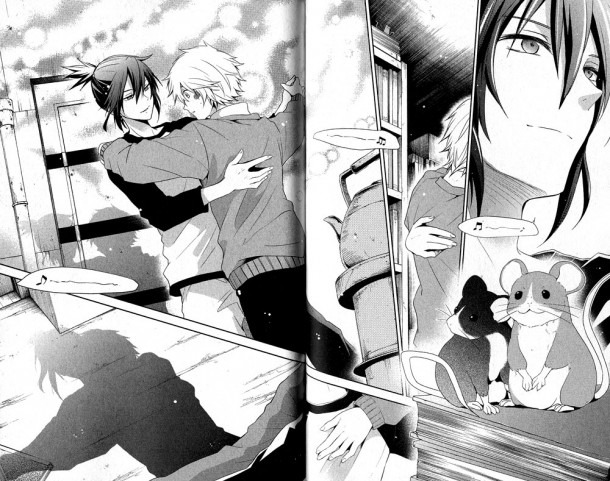
The part that touched me the most, though, was absolutely Miki's - or Miki and Shiori's, because she was absolutely no little part of it. Part of that was probably the context - I spent the last two days reading all of "Lady Georgie" which does colour one's view on not-quite-platonic brother-sister relationships. With spoilers unsaid, it is Miki's story that gets to bring some little completion to Utena's story in this volume, and it does so through a visual depiction of music which by coincidence I read while someone else in the room was listenint go something very suitable on youtube.

All in all, it was a quick read coloured by floating castles and rose petals and girls with swords, and it was utterly satisfactory even though it probably isn't that deep.
type_wild: (lol @ this - Riza and Otani)
Pity the foolish maiden who went on a two-week journey to the land of a vital manga market with the small suitcase, only to discover that oh crap, I love Tokyo Tarareba Girls. Six volumes are out in German this far, and to be fair, I'm promised 50% off of some textbooks relevant for work so I might just be shipping a box home anyway.

I've only read the first of those six volumes, but I like it a lot and I've no doubt I'll get the rest. It's not mindblowing at this point, but it's cute and it's funny and it's touching onto a topic that I'd love to say I was self-assured enough to not be dwelling on on occasion even though I'm both comfortable and confident in my asexuality. And to be fair, I don't think it's so much the non-confidence in the fact that the only time in my life I've wanted a romantic relationship was when I was the unpopular girl who still spent more time fantasizing about being BFFs with one of the popular girls. Rather, it's that extremely pervasive mindset that a woman is a "girl" until she's married and mothered. It's a mindset that is being criticised here (the afterword goes into great detail about that), but it's still one that hits closer to home than I'd like. I might write more about that whenever I've read the full manga, but suffice it to say that there was an uncomfortable level of recognition here for ladies who are single at thirty-three (or four, as the case might be).

I also picked up one of the "special collections" of Detective Conan, this one with the focus on the "life and death situations". It's got the one the bomb in the tower where there's apparently some real Takagi/Sato development, so I clearly need it. It's also got bits with some of the other characters I never got around to by following the publishing order, so I guess that's exciting. Best of all, the first case had a real shippy moment between Conan and Ai and I am easy. But mostly I just love that dumb detective comic a lot okay, and I wish the English-speaking internet would open its eyes to it already.
type_wild: (Stare - Subaru and Hokuto)
When that EFL teachers on facebook ask for "comics or other kinds of easy readers" and within three comments they're recommending looking up "manga" in the import stores and sharing scanlation sites
type_wild: (So what - Waya)


To this day, I can only recall one comic depicting dancing-in-motion in a way that worked, in a way that didn't make me cringe on some level: Calvin and Hobbes. Twice, in fact.

This isn't to say that dancing in comics per definition doesn't work: The final pages of Victorian Romance Emma proves this plenty. The dance scene in NO. 6 is also fine, if far from as impactful as the corresponding scene in the anime. Elfquest varies. Some places it's fine. In others it's just some level that doesn't work like the rest of the story (the first Go-Back "dance"), and some are flat-out awkward. I can recognise that Leetah and Moonshade are supposed to be beautiful in that scene early on in Siege of Blue Mountain, but it's just weird. And then there's this page which is cringe (extra bad because it follows a chapter ending with brilliant pacing of some three simultaneous events, if you read the collected stories rather than the individual issues).

The above page from This One Summer continues the trend. Dancing is motion, but comics are per definition still shots. In the terminology of Scott McCloud, all action in a comic happens in the space between the panels. Also, the bigger the panel, the longer the eye lingers. The attempt at depicting the motion and energy of dancing by way of depicting a number of separate moves end up having the exact opposit effect of what you wanted. What would come across as motion if animated by the film reel, comes across as something corresponding slo-mo on the comic page.

Switch angles and focus and zoom.

Let time pass between each frame

Drawing out every fifth frame of some hypotehtical animation doesn't work the way you think it will, so don't do it.


And while we're at it: Can we please please please please stop making children's books "mixing comics and prose" the only time it wasn't a horror to read it was one that kept its pages as either prose only or comic only and even that one would've probably been better off by being either one. IT DOESN'T WORK. IT NEVER HAS. CAN WE NOT.
type_wild: (Default)
For today's lesson in how weirdly sensitive I am to how stories do romance: I'd have forgiven it all the suck and weird storytelling choices if Kimo and Mender had switched places, and I'm perfectly serious about it.

But the general lack of quality has put me in the previously unfamiliar dilemma of pirating things readily available in languages I understand. Had this comic been anything else than Elfquest, I'd have dropped it long since. But it is Elfquest and my appreciation of the Pinis' previous work means that I want to do my share to support them. And so I'll probably buy the last Final Quest collection whenever it comes out, while doing something I wouldn't have dreamed of doing three years ago: Looking up the single issues online to cringe.

I just really want to pretend that Elfquest ended with Wild Hunt.

Obviously spoilery commentary up until issue 22, with reaction gifs )
type_wild: (Smile - Suguru)
The Thing With Franco-Belgian Comics is that I buy them 110% for the nostalgia value, though which nostalgia here is debatable - the only one of them belonging to my childhood is Asterix. I never much cared for Tintin (it's the art); Spirou and Fantasio I only really discovered as an adult, and I love it but it's also kinda... hard to defend, on quality measures? It's essentially a fifties boys' adventure series that never really grew out of the fifties, and god only knows what it sells itself on these days. It's not parody the way Asterix was parody, it's not really comedy, very shallowly political, and the format is too short to allow for drama or engaging plots. I guess it's essentially aimed at the same market as the Donald Duck pocket books, except that they clearly have some kind of artistic ambition; The Moran and Munuera run might've had some storytelling issues, but I forgive them all of it, all of it, for how bloody gorgeous those pages are.

So also with The One With Borneo. No, no panning citiscapes or actions scenes in breathtaking angles, but a lot of really gorgeous animals, really pretty Franco-Belgian backgrounds, and that one thing that I love so much about modern Spirou: they've taken the European caricatured style out of its original stiff format and made it work with dynamic panels, in closeups and in serious scenes. This one is particularly good at it. There are also some dream sequences that honestly work a lot better for me than non-verbal dream sequences in comics normally do. Can't say much about the story: It's Spirou and Fantasio, it's a fifties boys' adventure story with a fixed ending and an appropriately politically correct moral. I'm not reading this for the plot and neither are you.

I'm also 95% certain that Spirou and Fantasio are a couple in this one, and believe me, having Spirou flirt with the Cute Art Teacher on the literal final page of the story just cements it further.
type_wild: (Default)
I called Heart of Thomas the grandfather of mothern BL, and the father is, in our context, Maki Murakami's Gravitation.

a comparison of their glaringly obviuos common points )
type_wild: (Tea - Masako)
School update:

1) No, there's no extra reading for writing the 5big paper, that was the uni webpage lying (they're also lying about the due date, but that was a matter of three days - I mean, just to note how they're being Very Professional)

2) Thus far, the part about the dialects has been repetition of what I did this autumn, just in my native language and in far more detail. So it's somewhere between "convenient repetition" and "wow I knew all of this already", and let's hope it continues like that.


INSTEAD, let's talk about how my incentive for finally learning Japanese arrived in the post


cut for pics )

I should probably write something about that, I guess, but the long and short of it is that ever since I discovered this half-scanlated masterpiece three years ago, I've been kinda serious about learning Japanese, because - I guess - I finally have an excuse.

So yeah, those things I said about fic in the last post? My prejudices and internalised resentment of the fangirl was not limited to that. I'll claim to be into comics and cartoons (no, I'll never call it "sequential art" and "animated film"), but the truth of it is that at least half of what I've consumed of those artforms since I was sixteen or so has been from Japan, and if that had been in any other language, then I'd sat down to learn it years ago, for sure. My ambitions about learning French might've started with some studies I read for my MA that didn't bother translating the French excerpts it used to illustrate the evolution of a certain novel format, but these days? Sure, I still want to learn French, but that's mostly because of the infuriatingly slow translation of Spirou et Fantasio around here.

But French has, well, it has history, it has class, it has a number of things to say about half of Europe's languages but English most pressingly, but Japanese is weabo and certainly when you're doing it because of the comics. The hilarious part is that I have absolutely no prejudices against other people learning it just for the comics, but desperately want to distance myself from it even if people IRL can clearly witness my FMA thermos mug.

And now I've paid enough money for Takemiya Keiko - oh, you don't want to know the story of me and the DVDs for Towards The Terra - for this to be justified.

Hiragana level: Practiced the s-row today
type_wild: (Stare - Subaru and Hokuto)
tl;dr watch them if you're a fan, but don't go to them if you want a taste of what the series are really about. This is Tsubasa on valium and xxxHolic on ACID.

Not really a review, because you don't need it )
type_wild: (Stare - Subaru and Hokuto)
SooOO Tokyo Babylon, boys and girls!
I just can't judge it at all )

Crossover count: The Clamp Campus series
type_wild: (Tea - Masako)
I read Blue Is The Warmest Colour and got into thinking about the whole thing with first person POV in comics, because it seems to be such a... kinda contradictory thing? The purpose of first person narration IS the extreme intimacy and subjectivity of hearing a story from a character's mouth, yet the comic as a medium necessarily robs us of that subjectivity by also giving us a view of the action that is only limited by the panel's focus.

You don't get to see a comic through a character's eyes because comics can't do the handheld camera bullshit and even film long since realised that an entire film emulating someone's POV would kill the audience

Anyway, I went over and did the count.


STATUS OF MY SHELVES, CA. NOW:

Maus (biography, ca. mid-seventies to mid eighties?): First person voice past (the father telling of his story) and present (Spiegelman's reflections upon his re-telling of it)

Hugo Tate (fiction, roughly nineteen eighties): First person voice used in journal entries and letters to friends and family that are so self-centred that they obviously are just journal entries in disguise (that is: present)

Odilou (fiction, mid-eighties to mid nineties?): First person voice present

Palestine (documentary, early to mid nineties): First person voice present

Understanding comics (documentary, mid nineties): First person voice present

Strangers in Paradise (fiction, mid-nineties to late noughties): First person voice of various characters, on different occasions, present except for in the epilogue

Persepolis, Embroideres (autobiography, early noughties): First person voice retrospective

Blankets (autobiography, mid-noughties): First person voice retrospective

Daisy Kutter - The Last Train (fiction, mid-noughties): First person, but sparingly used and mainly seems to substitute thought bubbles; retrospective in the epilogue

Elfquest: The Searcher and the Sword (fiction, late noughties): First person voice retrospective

Blue Is The Warmest Colour (fiction, late noughties): First person voice used in diary entries read within a frame story

Herr Merz (biography, coupla years ago): First person voice used by quoting letters and other writings on the subject

Are You My Mother? (biography/autobiography, coupla years ago): First person voice present


Very quick thoughts to this:
- Documentary is overrepresented, with well over half of the titles here being either non-fiction or lightly fictionalised real events (Maus, Persepolis, Blankets)

- Mainstream comics are also underrepresented, with only three titles whose open and stated goal is to be light and entertaining instead of some degree of "deep" (Daisy Kutter, SiP and that Elfquest one). The rest of them do clearly have various degrees of special audience that does not include the normal comic-reading lot. More telling about my comic tastes than anything, I guess: the non-artsy-fartsy titles are all independent.

- The topic-oriented documentaries on my list (Maus, Palestine, Herr Merz) dwell, to a surprising degree, on the artist's struggle with telling the story. Seriously: How often do you see documentary films, far less non-fictional book, that spend a good third of the story detailing how the documentarist is being torn about the topic they're uncovering? Understanding Comics is the one exception, but that one's more like a textbook anyway.

- Palestine and Understanding Comics are the only titles on this list that ultimately isn't focused on the life of one human being.


One interesting thing to note is that the only time I've found first person narration used in manga would be in four of the stories in Kaoru Mori's Anything and Something, all short and two of them instances of a one-sided conversation between a fictive, off-screen part through whose eyes the story is seen, and the on-screen, speaking part. This is probably where someone should comment on the creepy thing with this being scantily-clad women speaking indirectly to the reader of seinen manga, but that someone won't be me because Kaori Mori so very clearly loves women for something else than their butts even if she does have a thing for bunny suits.
type_wild: (Stare - Subaru and Hokuto)
Kind of OT about my experiences with and prejudices towards genre )


God only knows why it was I decided to read Kaze to Ki no Uta despite having seen it mentioned somewhere that it's full of abuse and ends as expected. I had things to do this weekend. They didn't happen.


It turns out they don't hand out those prestigious comic awards just for being controversial )


In conclusion: FFFFU- it appears I need to learn Japanese now.
type_wild: (Stare - Subaru and Hokuto)
I read "Suki, A Like Story" years ago, and wrote it off as boring and badly suffering from Clamp's icky ideas of how love works. I read it again, and I changed my mind. A bit.

Not as dumb as I used to think but still plenty uncomfortable )
type_wild: (So what - Waya)
I started re-reading Chobits but it got to the point where I just didn't feel like wasting more time on it and just skipped ahead to read all the "oh Clamp" parts. The conclusion would be that the series is very cute but particularly the early parts are pandering to an audience of which I am not a part. Unfortunately, the story fails to engage me like it should (thus the skipping) and the final conclusion is... yeah, more on that below.

I'll just say the two things I really liked: the art style and the way more or less every character was portrayed. Except for the part with the nineteen year old girl and the man who was twice her age and married to his computer, and not in the figurative way.

Quick thoughts )

Profile

type_wild: (Default)
Type Wild

July 2025

M T W T F S S
 123 456
78910111213
14151617181920
21222324252627
28293031   

Syndicate

RSS Atom

Most Popular Tags

About me

I like stories.

Style Credit

Expand Cut Tags

No cut tags
Page generated Jan. 16th, 2026 08:28 pm
Powered by Dreamwidth Studios